

Housing & Climate: Lessons from a Living Lab in the Galápagos
Analia Lourdes Pastran
Overview. Buildings are a frontline for climate mitigation and public health. In the Galápagos—where 97% of the territory is protected and electricity supply relies heavily on imported diesel—reducing building energy demand directly lowers emissions and operating costs while improving comfort. Evidence from the Living Lab for Sustainable Building (LLES) indicates that combining bioclimatic design, rehabilitation of existing stock, and local ordinances can reduce electricity use by 28–50% and stabilise indoor temperatures in warm, humid climates.
The Galápagos as a living lab
The LLES ran from May 2021 to May 2024 to transform public, residential, and tourism buildings with bioclimatic strategies and energy efficiency—tailored to island conditions and designed to endure political cycles.
The intervention prioritised passive cooling—solar control (shading, eaves, louvers), cross-ventilation, and envelope protection—to diminish thermal loads before equipment investments. Measures were organised in design packages adaptable by building typology (housing, educational, tourism), facilitating scalable application by local teams, and enabling consistent monitoring of outcomes.
In parallel, capacity development and institutionalisation were integral. A workshop-school model trained local trades; three demonstrator sites established proof-of-concept; and municipal ordinances in San Cristóbal, Santa Cruz, and Isabela embedded sustainable construction and rehabilitation into local regulatory frameworks.
Demonstrator Sites
● Holguín House (San Cristóbal): Mixed-use residential/productive building, showing comfort gains and utility savings achievable at a small scale.
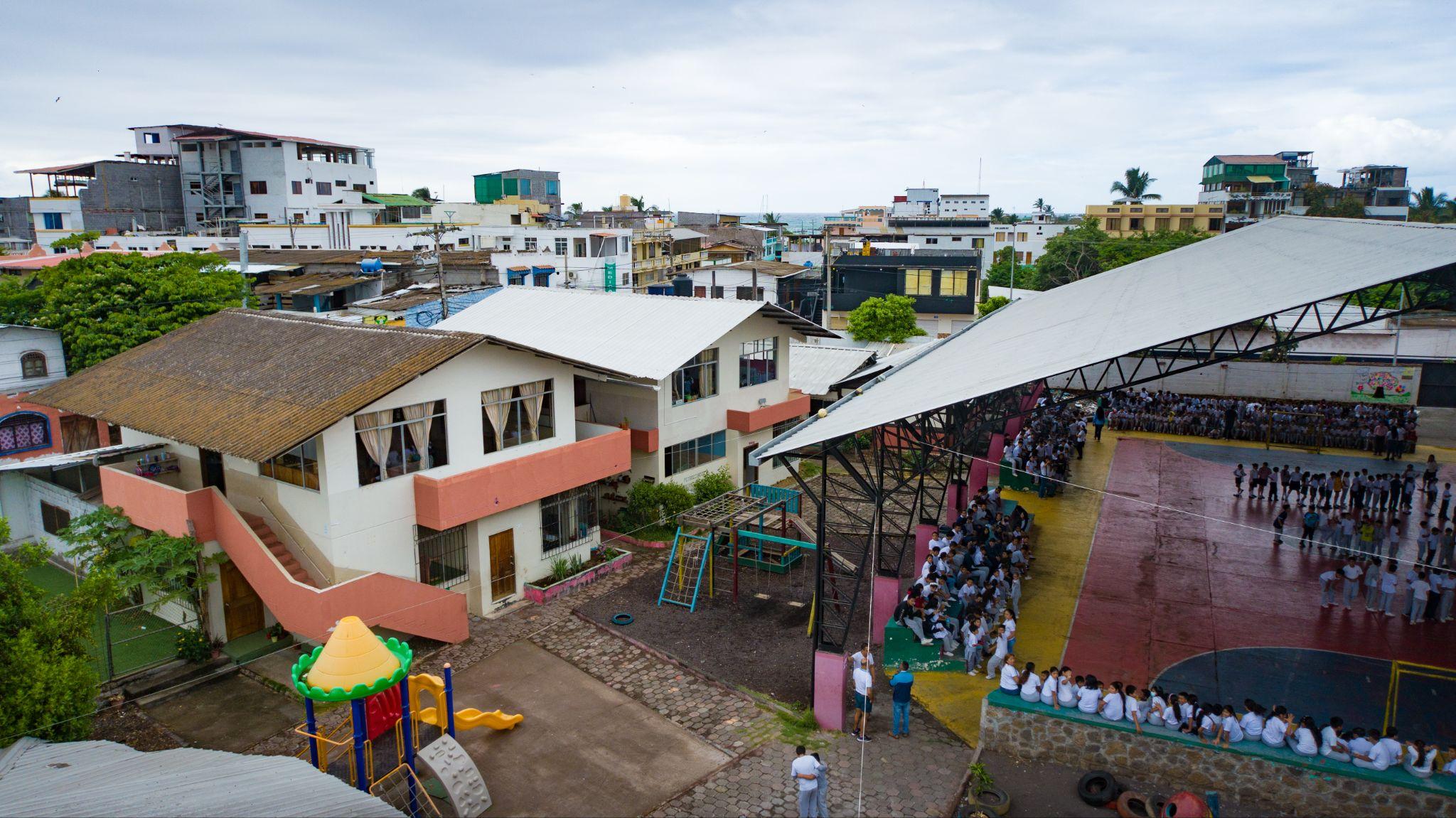
● Galo Plaza Lasso School (Santa Cruz): Public, high-occupancy facility, illustrating links between thermal comfort, learning conditions, and operating budgets.
● Hotel Paraíso de Isabela (Isabela): Tourism infrastructure, highlighting how efficiency strengthens local competitiveness and visitor experience.
Across sites, outcomes converged on lower electricity demand, more stable indoor conditions, and clear pathways for municipal scaling of rehabilitation strategies.
Partners & alignment
The initiative was funded by EUROCLIMA+ (EU) with technical support from AFD and AECID; the Governing Council of the Galápagos Special Regime (CGREG) and the municipalities of Santa Cruz, Isabela, and San Cristóbal served as local partners. Mentefactura carries out the implementation of the Living Lab Project. Fundación Futuro Latinoamericano (FFLA) and EBP Chile lead regional replication; Smartly sponsors international scaling. The work supports Ecuador’s NDC, the SDGs (7, 11, 13, 17), and the New Urban Agenda.
From the Galápagos to LAC
To replicate, LLES developed selection indicators for comparable island contexts. The first sites chosen were Holbox, Isla Mujeres, and Cozumel (Mexico) and San Andrés (Colombia). The replication method emphasises short diagnostics, hands-on workshops, site visits to retrofits, and a regional sustainable building network to maintain learning momentum. The objective was to scale effective measures quickly, with local capacity leading implementation.
Six takeaways for cities
1. Fix what exists first. Rehabilitation beats new build for near-term impact.
2. Pair policy with pilots. Ordinances + visible demonstrators accelerate adoption.
3. Go passive before equipment. Reduce thermal loads to shrink A/C needs.
4. Invest in skills. Workshop-schools and municipal supervision sustain quality.
5. Co-govern. Align local government, cooperation agencies, civil society, and the private sector.
6. Measure & tell the story. Track comfort/energy gains and share results to unlock finance.
Alignment with Global Agendas
The work contributed to Ecuador’s NDC, advances SDGs 7, 11, 13, and 17, and supports the New Urban Agenda by delivering practical, affordable measures that improve everyday well-being—healthier classrooms, more comfortable homes, and stronger local economies.
Urban Thinkers Campus: Green Construction Practices & Lessons Learned
As part of the Living Lab, an Urban Thinkers Campus (UTC)—under UN-Habitat’s World Urban Campaign—was convened to consolidate practice and policy on green construction in warm, humid climates. The UTC gathered local governments, technical agencies, academia, the private sector, and civil society to examine bioclimatic design, rehabilitation of existing stock, and regulatory instruments that sustain outcomes over time. The dialogue emphasized replicable measures, capacity development, and monitoring frameworks aligned with municipal mandates.
One of the lessons learned has been a profound understanding of how to capture local demands and contribute to the process of changing mindsets and improving sustainable building practices in the local community. Periodic activities, such as workshops, allowed the Project to gather the community’s feedback and adjust its targets accordingly, as well as to share information about sustainable construction practices.
Analia Lourdes Pastran, 2nd October 2025.
Source: summary of “Sustainability in the Built Environment: The Galapagos Experience,” IEEE Technology and Society Magazine, March 2024. Author: MSc. Analia Lourdes Pastran, Urban Economist and founder of Smartly.